
Don't Call It Optimism
Hope As A Verb

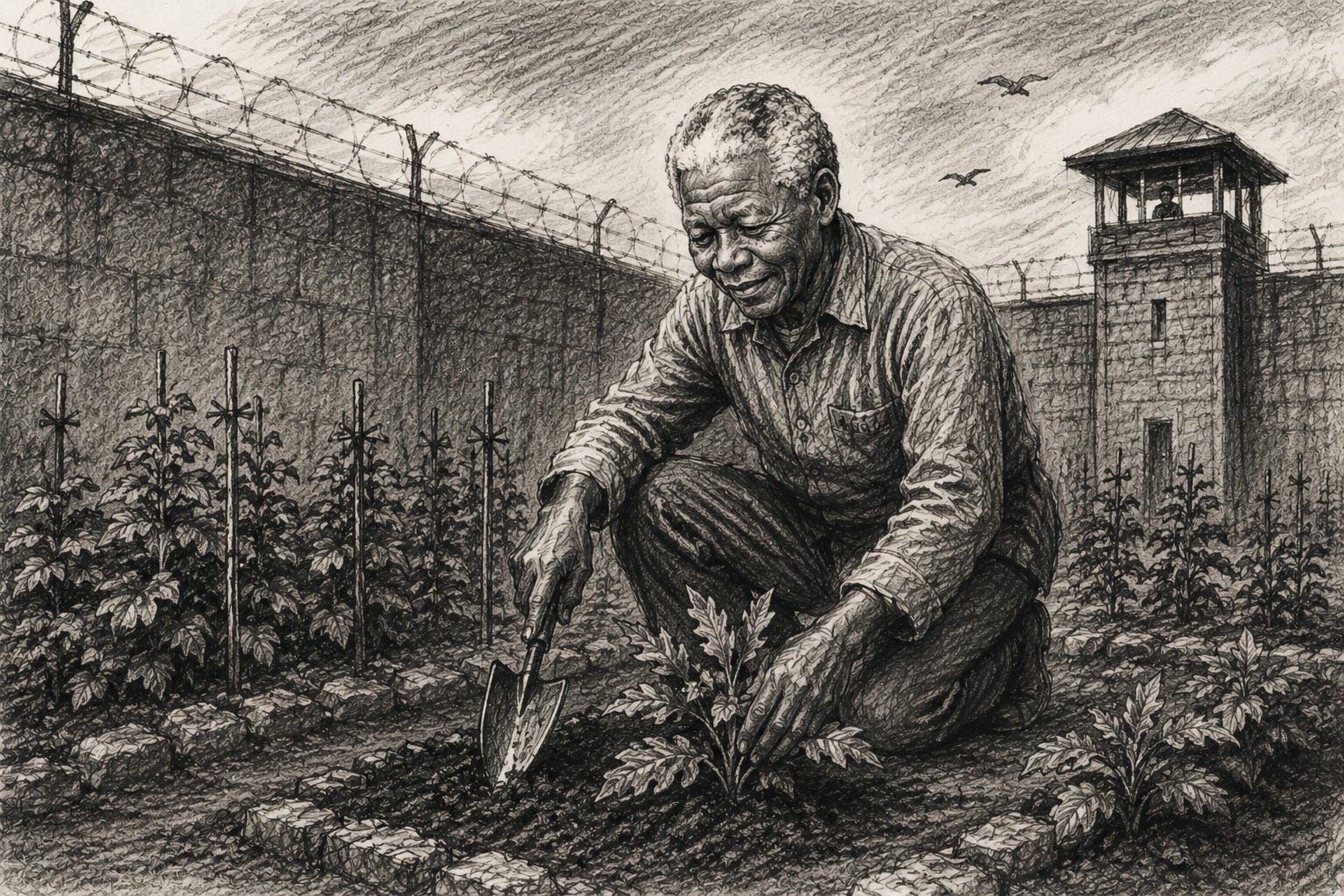
In June 1964, Nelson Mandela arrived at the prison on Robben Island to begin a sentence of life plus five years. He was forty-five years old. When he stepped off the ferry, the guards stripped him of his clothes and his dignity and assigned him a number. From that moment on, he was prisoner 466/64. The “64” was the year he arrived. The “466” meant he was the 466th person the South African government had decided to imprison on that island that year.
Robben Island sat about nine miles off the coast of Cape Town. For the men sent there, it was designed to be the end of their story.
Mandela spent years working in a lime quarry. It was a massive excavation site where the sun reflected off the white stone with a glare that eventually scarred the retinas of the prisoners and caused permanent damage to their tear ducts. They spent their days breaking boulders into gravel with picks and shovels. They breathed in white dust until their lungs burned. There was no evidence that their sacrifice mattered to anyone on the outside. There was no scheduled release date. There was no indication that the government was about to collapse. Nelson Mandela was a man being systematically erased from history, one shovelful of gravel at a time, with no foreseeable end to the story other than a pauper’s grave in the island’s cemetery.
During those years, he decided to do something that probably looked totally irrational to everyone around him: He decided to plant a garden.
He didn’t start with a plan or a budget. He just managed to get a handful of tomato seeds from a guard who had a little kindness left in him. The soil in the courtyard was packed hard and didn’t have much in the way of the nutrients plants need in order to grow. So Mandela and the other prisoners started what he called active collection. On their way back from the quarry each day, they stopped and gathered ostrich droppings. They carried them in their pockets and used them to fertilize the small, stubborn patch of dirt so it could support what they wanted to plant.
He eventually secured a larger strip of land against one of the prison walls and planted chili peppers, onions, and tomatoes. He spent the few hours they allowed him for rest on his hands and knees in the dirt, tending a makeshift garden that had no guarantee of flourishing.
On the day he planted those first seeds, Mandela had no idea that he would be released in twenty-six years. He was a man in his forties and then his fifties and sixties, tending a garden in a place he was told he would never leave.
He wrote about it later in his autobiography. He said that a garden was one of the few things in prison that one could control. “To plant a seed, watch it grow, to tend it and then harvest it offered a simple but enduring satisfaction. The sense of being the custodian of this small patch of earth offered a small taste of freedom.”
He didn’t plant those seeds and carry ostrich feces in his pockets out of some general sense of optimism. He did all of that because he refused to concede that the present moment was the final word.
Hope Leans In
For I consider that the sufferings of this present time are not worth comparing with the glory that is going to be revealed to us. For the creation eagerly waits with anticipation for God’s sons to be revealed. For the creation was subjected to futility - not willingly, but because of him who subjected it - in the hope that the creation itself will also be set free from the bondage to decay into the glorious freedom of God’s children. For we know that the whole creation has been groaning together with labor pains until now. Not only that, but we ourselves who have the Spirit as the firstfruits - we also groan within ourselves, eagerly waiting for adoption, the redemption of our bodies. Now in this hope we were saved, but hope that is seen is not hope, because who hopes for what he sees? Now if we hope for what we do not see, we eagerly wait for it with patience. Romans 8:18-25 (CSB)
When Paul gets to this part of his letter, he briefly starts to sound like a mathematician. He uses a Greek word that’s really a bookkeeping term here. It’s a word that’s used for settling an account or weighing two values against each other. He’s measuring the weight of the suffering his readers are enduring and comparing it to the weight of the glory he insists is coming. His conclusion is that they aren’t even in the same category. But, to be clear, he’s not dismissing their pain. He’s re-contextualizing it.
Then he describes the posture of all of creation with a word that literally means to crane one’s neck forward to see something on the horizon. It’s the image of a person standing on their tiptoes to see over a crowd. It’s a posture of intense, full-bodied anticipation. Creation isn’t just sitting back and waiting for things to change. Paul depicts Creation itself as leaning into the new world that God is bringing into existence.
This is where optimism and hope part ways. Merriam-Webster defines optimism as “an inclination to put the most favorable construction upon actions and events or to anticipate the best possible outcome.” Optimism is basically a passive forecast. It’s a feeling that things will probably get better based on current trends or a positive attitude. But Paul describes Creation as groaning in labor pains. They’re the groans of someone giving birth. It’s an active, painful process that is moving Creation toward something new. In Christ, we’re participating in a new birth that has already begun in Christ's resurrection.
Jürgen Moltmann spent decades working out what that actually means for the people of God. He said it better than I can:
“Pray and watch - that is only possible if we don’t pray mystically with closed eyes, but pray messianically, with eyes open for God’s future in the world. Christian faith is not blind faith. It is the wakeful expectation of God which touched all our senses. The early Christians prayed standing, looking up, with outstretched arms and wide-open eyes, ready to walk or to leap forward. We can see this from the pictures in the catacombs in Rome. Their posture reflects tense expectation, not quiet heart-searching. We don’t watch just because of the dangers that threaten us. We are expecting the salvation of the world. We are watching in God’s Advent. With tense attention, we open all our senses for the coming of God into our lives.”
- Jürgen Moltmann, Walking With God In A Fragile World
The people in the catacombs weren’t waiting for the empire to give them permission to believe God’s future was real. They had already chosen to live inside of it. Which is a good reminder for American Christians right now, because what passes for hope in a lot of our churches in 2026 looks a whole lot more like waiting for our preferred political outcome than like anything Paul was talking about.
When Words Run Out
In the same way, the Spirit also helps us in our weakness, because we do not know what to pray for as we should, but the Spirit himself intercedes for us with inexpressible groanings. And he who searches our hearts knows the mind of the Spirit, because he intercedes for the saints according to the will of God. We know that all things work together for the good of those who love God, who are called according to his purpose. For those he foreknew, he also predestined to be conformed to the image of his Son, so that he would be the firstborn among many brothers and sisters. And those he predestined, he also called; and those he called, he also justified; and those he justified, he also glorified. Romans 8:26-30 (CSB)
Paul was honest enough to admit that there are moments in the middle of the struggle where the words are hard to come by and completely inadequate anyway. He described a condition in which our suffering is so intense that we don’t even know what we ought to pray for, and wordless groans are the best we’ve got. If you’ve been there, you know exactly what he’s talking about. If you haven’t been there, I guarantee you will be at some point.
This is a mode of active hope that we probably don’t talk about enough. It’s the conviction that when we’re broken, when we feel abandoned and alone, when we don’t even know what to pray for and wouldn’t have the words for it if we did, God’s Spirit searches our hearts and provides the prayer back to God for us. Rather than seeing us as inadequate because of our weakness, the God most clearly seen in Jesus meets us inside of it.
Verse 28 often gets quoted to mean that everything will eventually work out for our personal comfort or circumstantial success. But God doesn’t promise to grant our wishes like a genie, despite what the TV preachers tell you. What God actually promises is to use our circumstances to make us more like Christ, and not to abandon us in the process. Whatever the forces of evil in this broken world throw at us, God can still use it toward something good. That’s profoundly different than the interpretation that says God causes awful things to shape us into what he wants, as if God would give your kid bone cancer to make you a little more patient (and that would somehow be considered good). For the record, that god would be a monster, and I would certainly reject such a god in the name of Jesus.
Think about what Nelson Mandela was doing in that prison courtyard. He wasn’t tending his garden because he had a feeling everything was just going to work out, or because the prison had some great agriculture program for the inmates. He was tending it because it was a way to maintain his humanity in a place that was specifically designed to destroy it. That’s what God’s Spirit is doing in us. The groaning is evidence that the life of God’s future is already pressing against the limitations of the present. You know those wordless groans he mentioned? Read that in context. It’s a direct callback to the groans of creation he was just talking about. And what did Paul say about the groans of creation? They were the sound of something new being born.
Hope is the decision to stay in the dirt and tend the garden, trusting the Gardener even when the harvest is nowhere in sight.
The thing is, people of faith aren’t the people of the wait-and-see. We are those who’ve been called to a purpose that’s bigger and more comprehensive than mere survival. We’re being shaped into a people who can reflect the glory of God and bear the image of Christ because we’ve been refined in the fire of our past and present suffering.
You know that groan you feel deep in your soul sometimes? That’s the sound of a new world being born.
(And please, let’s not get bogged down in the predestination language in verses 29 and 30. I’m not sure any debate could miss the point of a biblical passage more thoroughly than that one does. Paul is not shoehorning a systematic theology of “divine election” into what he’s actually doing in this passage. He’s saying: God knows how the story ends and that’s our destiny, if we choose to accept it.)
Not to get too nerdy, but Moltmann argued that God’s relationship to the world is not spatial but temporal - not that God is “above” history looking down, but that God is “ahead” of history, drawing creation forward. In Religion, Revolution, and the Future, he put it this way:
“God is not ‘above us’ in a spatial sense, but he is ‘before us’ in a temporal sense. He is the God whose very essence is future... This God beckons us forward into the unknown, into the promised land of his future.”
- Jürgen Moltmann, Religion, Revolution, and the Future (1969)
Through faith and hope, we are the people who live out the Already in the middle of the Not Yet.
More Than Conquerors
What, then, are we to say about these things? If God is for us, who is against us? He did not even spare his own Son but gave him up for us all. How will he not also with him grant us everything? Who can bring an accusation against God’s elect? God is the one who justifies. Who is the one who condemns? Christ Jesus is the one who died, but even more, has been raised; he also is at the right hand of God and intercedes for us. Who can separate us from the love of Christ? Can affliction or distress or persecution or famine or nakedness or danger or sword? As it is written: “Because of you we are being put to death all day long; we are counted as sheep to be slaughtered.” No, in all these things we are more than conquerors through him who loved us. For I am persuaded that neither death nor life, nor angels nor rulers, nor things present nor things to come, nor powers, nor height nor depth, nor any other created thing will be able to separate us from the love of God that is in Christ Jesus our Lord. Romans 8:31-39 (CSB)
Paul brings his entire argument home with a series of rhetorical questions he doesn’t expect anyone to answer, because the questions themselves imply the answer.
But before we get there, we need to look a little closer at the question itself. “If God is for us” is not some declaration that God is our team mascot, or that our side gets divine endorsement simply because we showed up and said the right things. The prophets actually describe that kind of thing as taking the name of the Lord in vain. Using God’s name to sanctify your own agenda is as old as the kings of Israel demanding divine blessing for wars God never wanted. What Paul is actually describing is something much more demanding: the assurance that comes to those whose lives have been surrendered to what God actually wants for the world. To say “God is for us” is a statement about whose agenda you’ve adopted, not about whose side God has supposedly been recruited to.
Here’s the thing about optimism: at its worst, it can actually make us complicit in great evil. If we sit back, stick our heads in the sand, and wait for God to take care of it, we’ve mistaken passive sentiment for active faithfulness.
In 2026, a version of Christianity is operating in the United States that seems to have convinced itself that it’s practicing hope when it’s mostly just waiting for its preferred political coalition to finish winning. It has marched itself to the National Mall, attached itself to the machinery of political power, and dressed its ambitions in the language of divine mandate. The V-Dem Institute’s 2026 Democracy Report downgraded the United States from a “liberal democracy” to an “electoral democracy” for the first time since 1965, and researchers who study democratic decline now compare American democracy to countries like Mexico, South Africa, and India rather than to the stable democracies of Western Europe and Japan. The institutions that were supposed to hold power accountable are under sustained pressure. And a significant portion of the American church isn’t calling that out, because it’s inside the building helping run it.
Walter Wink called these structures the “domination system.” He spent his life arguing that the church’s vocation was never to sanctify whatever power happened to be in charge, but to embody a visible alternative to it. Paul understood this. Rome didn’t get a theological endorsement from Paul. It got lumped in with every power in the cosmos that would love to separate us from the love of God, and Paul’s answer was that none of them are strong enough to do it.
It is possible to work against God’s purposes, and it is certainly possible to ignore his will, but it is not possible to make God stop loving you. That may not be as comforting as it sounds. A God who stopped loving you might just ignore you and what you are doing in his name. A God that loves you is invested.
Hope is something profoundly different from all of that. Hope is active participation in a victory that’s already been won. God is beckoning us forward into His future, even as God is actively bringing His future toward us.
Then Paul closes his argument by listing everything that can go wrong: affliction, distress, persecution, famine, nakedness, danger, and sword. He says he’s convinced that none of it is powerful enough to separate us from the love of God. From there, he expands the scale to include death and life and angels and rulers and every power in existence, things present and things to come, and his verdict doesn’t change. Paul insists the love of God is the only force in the universe that can’t be exhausted.
And that’s exactly why hope isn’t optimism. Optimism sits back and assumes things will work out. Hope knows that the God whose love can’t be exhausted is calling us forward into a future where that love gets the final word, and that we’re invited to participate in bringing it about. A love like that doesn’t produce spectators. It produces people who plant things and build things and show up for things when there’s no guarantee any of it will survive the season.
Don’t call it optimism. Don’t you dare reduce something as powerful as hope to something as anemic as that. As with most things, Jürgen Moltmann says it better than I can:
“That is why faith, wherever it develops into hope, causes not rest but unrest, not patience but impatience. It does not calm the unquiet heart, but is itself this unquiet heart in man. Those who hope in Christ can no longer put up with reality as it is, but begin to suffer under it, to contradict it. Peace with God means conflict with the world, for the goad of the promised future stabs inexorably into the flesh of every unfulfilled present.”
-Jürgen Moltmann, Theology of Hope
Thank you.
Sometimes I find the tension between the already and the not yet very tiring. But the Spirit sustains me and all creation. Thanks for your article.